

Supplier Report: 8/6/2016

Drowning

Yet another week where M&A dominates the news.

Verizon bought another company (Fleetmatics), SalesForce purchased Quip, and there are rumors that HPE might be up for sale (all of it or some of it). IBM is showing interest in purchasing point of sale company Revel.

IBM is also actually responsible for some technology news this week.  Their health AI systems are starting to target cancer symptoms as a means of early detection. They also maybe created an artificial neuron for super computers.

IBM

  • IBM IC detects cancer before symptoms appear

    “The societal impact of this research is that it could enable physicians to detect cancer early…when there are more possibilities of being cured,” Stolovitzky said. “We wanted this research to be in the area of cancer and also the area of detecting DNA and viruses like Zika. Everything reduces down to the same thing: being able to have a small and affordable diagnostic tool that can detect minute quantities of biomarker particles that tell physicians something about a person’s health.”scale of biology

    http://www.electronicsweekly.com/market-sectors/medical-electronics/ibm-ic-detects-cancer-before-symptoms-appear-2016-08/

  • IBM is reportedly in talks to buy point-of-sale software firm Revel Systems

    Bloomberg reports IBM (IBM) is in early talks to acquire Revel Systems, provider of an iPad-based point-of-sale (POS) hardware and software system for merchants.

    Revel competes with Square, PayPal (PYPL) , NCR (NCR) and others in the iPad POS market; its customers include Cinnabon, Chobani, and Popeyes. It has 750 employees, and was valued at more than $500 million in a $13.5 million 2015 funding round.

    https://www.thestreet.com/story/13660304/1/verizon-makes-a-telematics-acquisition-ibm-reportedly-mulls-a-retail-acquisition.html
    Is IBM Setting Up To Buy Revel Systems?

    With a Revel acquisition, IBM could theoretically refill a hole in its product line that has existed since the firm sold its point-of-sale business to Toshiba for $800 million in 2012. Revel, on the other hand, could possibly find itself with a soft exit from a market where funding rounds are getting fewer and further between.

    http://www.pymnts.com/news/point-of-sale/2016/ibm-acquire-revel-rumors/

  • IBM creates first-ever artificial neurons that behave like the real thing

    IBM researchers in Switzerland have created an artificial neuron that behaves just like the real thing. For the first time in history, artificial phase-change neurons have been grouped together (in a population of 500 synthesized in a lab) to process a neurological signal in more or less the same way that biological neurons transmit messages. They can be made exceptionally small and are similar in power and energy usage to biological neurons, and can even produce results with random variations, also just like biological neurons.

    http://inhabitat.com/ibm-creates-first-ever-artificial-neurons-that-behave-like-the-real-thing/

  • IBM’s Wager on Open Source Is Still Paying Off

    “It became apparent that open source could be the de facto standards we needed to be the engine to go out and drive things,” Moore said in his keynote at ApacheCon. “[The contributions] were bets; we didn’t know how this was going to come out, and we didn’t know if open source would grow, we knew there would be roadblocks and things we’d have to overcome along the way, but it had promise. We thought this would be the way of the future.”

    https://www.linux.com/news/ibms-wager-open-source-still-paying

Hewlett Packard Enterprise | HP Inc

  • Is Hewlett Packard Enterprise up for sale?

    As explained by author Kevin McLaughlin, “a buyout would allow HPE, currently the world’s largest seller of servers and storage systems, to streamline outside the glare of public scrutiny.”

    Following McLaughlin’s claims, shares in the company spiked seven percent on the stock exchange, yet closed around 3.5 percent as more details of the potential deal emerged.

    According to Reuters, the firms are focused on acquiring certain software assets from the vendor, worth somewhere between $US6 billion and $US8 billion, rather than the entire company.

    http://www.arnnet.com.au/article/604318/hewlett-packard-enterprise-up-sale/
    HPE Reportedly Considers Going Private

    Reuters reported last week that sources familiar with the HPE private equity discussion said that buyout firms are focused on acquiring some software assets that HPE has been considering divesting, and that those are worth between $6 billion and $8 billion.

    The Reuters report added that the deal was for just the software assets and not the entire company. HPE’s software assets include technology gained in acquisitions such as Vertica Systems, Autonomy, and Mercury. The technologies include data analytics, cloud orchestration, and systems management. That group hasn’t been paying off as strongly as the company’s hardware business has.

    http://www.informationweek.com/software/hpe-reportedly-considers-going-private/d/d-id/1326467
    $40 billion buyout rumour persists as HPE cloud chief and storage boss leave company

    A number of key executives are to leave Hewlett Packard Enterprise, with the top-level departures coming at a time when rumours abound that the company is subject to a $40 billion takeover attempt.

    Head of Cloud Bill Hilf, along with Manish Goel, HPE’s storage boss, are set to leave the company for pastures new. However, the reshuffle did not stop there, with Robert Vriji, managing director of sales for the Americas also set to leave, as well as the high-profile retirement of Martin Fink, CTO and head of HP Labs. Fink will retire at the end of the year.

    http://www.cbronline.com/news/verticals/the-boardroom/40-billion-buyout-rumour-persists-as-hpe-cloud-chief-and-storage-boss-leave-company-4966767

  • PE Firms Looking to Acquire Hewlett Packard Enterprise Software Assets Worth $6B-$8B

    Private equity firms, including KKR NYSEKK, Apollo and Carlyle Group are seeking to acquire certain software assets from Hewlett Packard Enterprise, according to sources reported by Reuters on Friday. Earlier in the day, The Information reported those firms might make a bid for all of HPE.

    Hewlett Packard Enterprise declined comment on the report, while KKR, Apollo and Carlyle did not comment.

    http://www.benzinga.com/news/16/07/8282979/bemzingas-weekend-m-a-chatter

Storage

  • INFINIDAT Reports 60% Quarter Over Quarter Growth in Q2

    INFINIDAT continued to achieve significant sales traction in key vertical markets in Q2, reporting that 32 percent of sales was to leading firms in the finance sector, 28 percent was in technology, telecommunications and cloud services, and 24 percent was in healthcare and life sciences. INFINIDAT added several new customers in Q2, including BT (world-leading communications services provider), HMSA/Hawaii Medical Service Association (health insurer), Triple C (cloud services provider), and Credit Andorra (financial services).

    http://www.cso.com.au/mediareleases/27834/infinidat-reports-60-quarter-over-quarter-growth/

  • How Dell Raised $67 Billion for the Biggest Tech Deal Ever

    Some of Dell’s own potential banks balked early on, arguing that they simply could not sell enough junk bonds to finance the deal, and other lenders refused to participate if they could not easily resell some of the loans to other investors.

    Then Dell, Silver Lake and the bankers came up with an idea, pushed hard by Mr. Durban: Sell more high-rated loans and bonds, a questionable idea for a junk-rated company like Dell.

    http://www.nytimes.com/2016/08/06/business/dealbook/how-dell-pieced-together-67-billion-to-buy-emc.html

Other

  • Oracle’s Latest Purchase Opens the Door for More Pricey Tech Deals

    Software-as-a-Service (SaaS) companies like Salesforce, which deliver software over the Internet, are of particular interest because that sales delivery model is becoming more successful with corporate customers. Neeraj Agrawal, a general partner with Battery Ventures, estimates that SaaS—as hot as it’s been—still represents just 15% of current software market, but he suggests that won’t be the case for long.

    http://fortune.com/2016/07/29/oracle-netsuite-tech-mergers/

  • Verizon buys Fleetmatics for $2.4B in cash to step up in telematics

    More generally, the acquisition of Fleetmatics points to ways that Verizon is continuing to use its balance sheet to finance investments into newer areas to offset continuing declines in its core, legacy business of basic phone services. As that market has become increasingly commoditized and people turn to other, digitised forms of communication away from traditional voice services, Verizon is hoping to invest into newer areas to move beyond “dumb pipe” status to keep its margins up, and revenues growing.

    While its acquisition of AOL (and now Yahoo) will help Verizon scale up its media, advertising and content operations, Fleetmatics is pointing straight to Verizon’s ambitions in enterprise services, and specifically enterprise mobility.

    https://techcrunch.com/2016/08/01/verizon-buys-fleetmatics-for-2-4b-in-cash-to-step-up-in-telematics
    sn_ryback_fmm

  • Salesforce buys word processing app Quip for $750M

    It’s not clear why Quip — which was growing and in the enviable position of being very selective about taking funding from VCs — decided to sell up to Salesforce. But it’s an interesting turn in the ongoing consolidation that we’ve seen in the enterprise market, and how that is transforming the bigger companies that are doing the buying.

    https://techcrunch.com/2016/08/01/salesforce-buys-word-processing-app-quip-for-750m/

  • AWS prints money for Amazon, but can Microsoft, Google and IBM catch up?

    As revealed last week, the AWS division of Amazon reported 58 percent year-to-year growth to almost $US2.9 billion, supported by continued operating efficiency that enabled the business to reach $US718 million in operating profit.

    Worldwide Cloud infrastructure services expenditure grew 52.3 percent year on year in Q2 2016, with Canalys findings pitching AWS as the leading Cloud infrastructure services provider, accounting for 30.4 percent of total spend.

    http://www.arnnet.com.au/article/604414/aws-prints-money-amazon-can-microsoft-google-ibm-catch-up/

  • Is the End Near for Tableau Software Inc?

    Data visualization company, Tableau is scheduled to report second quarter earnings tonight, after the market closes. The stock is perpetually one of the most beaten down during earnings season. After Q4 earnings, shares dropped nearly 50%, only to drop an additional 10% following Q1 earnings. Early indications appear as if they are heading in the same direction ahead of tonight’s report. Just this week Deutsche Bank downgraded the stock to “hold” from “buy” on concerns of slow margin growth. For Tableau to stop the slow bleed, it will have to convince investors that this and future quarters can generate sustainable growth.

    http://www.valuewalk.com/2016/08/tableau-software-inc-data-shortsell-earnings/

  • Teradata: Could This Be The Start Of Something Big?

    At this point, TDC has more than $7.20/share in cash although 98% of the cash is offshore. It also has long-term debt of $552 million. The current enterprise value is $3.44 billion which produces an EV/S for the current year of 1.49X. Based on the company’s current projection, the free cash flow yield for TDC will be 8% or so. The company indicated that there is potential upside to the free cash flow estimate based on the year-ending profile of assets and liabilities, particularly A/R. The company has a P/E of 12X current year non-GAAP earnings. Stock-based comp is quite low at around 10% of reported non-GAAP earnings. The other adjusting items have to do with one-time charges related to the disposition of the company’s marketing assets business as well as reorganization costs. With those kind of valuation metrics, there is plenty of upside if the company’s efforts to re-invent itself are even marginally successful. With that level of valuation, the company presents a very attractive acquisition target to both strategic and private equity investors. In the wake of the company’s guidance for the next two quarters, I think downside exposure is very limited as well.

    http://seekingalpha.com/article/3994915-teradata-start-something-big
    Big Data acquisitions: All about the enterprise

    Why would Teradata execute a services play not just once, but twice? Ultimately, it would seem to come down to Enterprise sales. Implementing big data — and doing it successfully — is still hard, and experienced consulting shops/Systems Integrators (SIs) can make enterprise customers feel a lot more confident moving forward with it. That puts them in the perfect position to recommend tools and technologies. So, having a manageably small, but geographically distributed, services organization can be very helpful to Teradata indeed.

    http://www.zdnet.com/article/big-data-acquisitions-all-about-the-enterprise/

Photo: Phoebe Dill

Supplier Report: 7/30/2016

sn_docks_Austin Neill

For weeks we have been asking if Java is dead… while the rumors of its demise may have been greatly exaggerated, Google may have created the final nail for Java’s future coffin.

Speaking of the future, does IBM have their eyes set on the golden goose Cerner? Acquiring Cerner would finally get them access to hospital information they so desperately want. While IBM is pining for a purchase, Oracle made a big one happen by grabbing NetSuite for $9.3B. Of course we can’t ignore Verizon’s purchase of Yahoo, oh wait I dedicated a whole podcast to that move.

Microsoft seems to be in a funk this week with news that they are cutting employees and potentially misrepresenting their cloud growth (yes, Microsoft too).

IBM

  • Cerner Could Be a Prized Asset for IBM

    To date the only active buyer on the health care front when it comes to large mega cap companies is IBM (IBM) , though its one missing link is access to hospitals, explained Mohan Naidu of Oppenheimer on Tuesday.

    While Cerner would fill that gap, Naidu cautioned that the likelihood of a potential deal comes down to both timing and how much IBM would be willing to pay. The health care IT firm’s scarcity value would likely require a pretty hefty premium, he said.

    Morningstar Inc. analyst Vishnu Lekraj added on Tuesday that Cerner is viewed as a “crowned jewel” in the health care IT space, describing its software assets as top tier in the industry and a “big prize” to gain: “To a company that’s lacking in servicing health care it would be a prime target,” he said.

    https://www.thestreet.com/story/13653083/1/cerner-could-be-a-prized-asset-for-ibm.html
    Note: IBM has approximately $14B in cash as of 3/31/2016 (credit: Spoons)

  • IBM Hired Hundreds of Designers to Figure Out What Customers Want

    So to shake up the status quo, IBM, Cognizant, Infosys and others have been racing to hire thousands of designers who once would have taken more specialized jobs—at an ad agency, say, or an industrial-design shop. At IBM, they team up with engineers and consultants and embed with a multiplicity of clients. Besides providing customer insights, the teams encourage constant feedback and tweak products as they’re built—a process aimed at getting them out faster. It’s how successful Silicon Valley startups operate but radical for the IT services industry.

    http://www.bloomberg.com/news/articles/2016-07-25/ibm-hired-hundreds-of-designers-to-figure-out-what-customers-want

  • IBM to deploy recruitment process automation at ITC Infotech

    The implementation will help us enhance employee experience. This will create visibility in social media and provide real time data and dashboards. We hope that this will also help us improve recruitment efficiency in terms of cost, productivity and time to fulfill, added Anand Talwar, Chief Human Resource Officer, ITC Infotech.

    http://www.financialexpress.com/industry/companies/ibm-to-deploy-recruitment-process-automation-at-itc-infotech/328122/

Oracle

  • Oracle buys enterprise cloud services company NetSuite for $9.3B
    The rumors are true…

    Oracle will acquire NetSuite for about $9.3 billion, or $109 per share in an all-cash deal, the companies announced Thursday. Both Oracle and NetSuite’s cloud service offerings aimed at enterprise customers will continue to operate and “coexist in the marketplace forever,” according to a statement by Oracle CEO Mark Hurd.

    https://techcrunch.com/2016/07/28/oracle-buys-enterprise-cloud-services-company-netsuite-for-9-3b/
    The Flawed Logic Behind Oracle’s NetSuite Deal

    Oracle Corp.’s $9.3 billion bid for cloud financial software provider NetSuite should help boost Oracle’s lagging cloud business. But Oracle is paying a high price, particularly as NetSuite is too small to really move the needle for Oracle. Another big issue: NetSuite plays in a software category—financial management systems—whose mojo is being sapped by newer apps.

    https://www.theinformation.com/the-flawed-logic-behind-oracles-netsuite-deal
    A look at Oracle’s 10 biggest acquisitions
    http://www.networkworld.com/article/3101876/software/a-look-at-oracle-s-10-biggest-acquisitions.html

  • Pulling back the covers on Oracle lawsuit: State could spend $27 million in legal fees

    According to the Oregon Legislative Fiscal Office, the state has spent nearly $16 million so far building its case that the giant software company badly bungled development of the Cover Oregon heath-care exchange. With the trial not set to begin until January, the Department of Justice has estimated the cost of the lawsuit could top $27 million by next April, making it one of the most expensive in department history.

    “I had feared it would be extremely high, but my God, I’m shocked by that number,” said Mike McLane, House Republican leader.

    http://www.oregonlive.com/business/index.ssf/2016/07/puling_back_the_covers_on_orac.html

Microsoft

  • Is Microsoft Massively Overstating Its Cloud Revenues?
    Another cloud provider, another rumor of misreported revenues…

    In its quarterly 10-Q filing with the SEC from April, Microsoft breaks out the specific products it includes in its commercial cloud figure in the following way, “Our commercial cloud … primarily comprises Office 365 Commercial, Microsoft Azure, and Dynamics CRM Online.” As such, Microsoft’s commercial cloud pulls sales from two different official reporting divisions — intelligent cloud and productivity and business processes — each of which contains several unique products, making it guesswork at best to glean how much of that stated $12 billion in sales belongs to which product.

    The same problem exists in the intelligent cloud reporting segment, making it frustratingly difficult to gauge the progress of this strategic imperative. When Microsoft announced its new financial reporting structure, it outlined intelligent cloud as including “results from public, private and hybrid server products and services such as Windows Server, SQL Server, System Center, Azure, and Enterprise Services.”

    http://host.madison.com/business/investment/markets-and-stocks/is-microsoft-massively-overstating-its-cloud-revenues/article_985d1685-e5dd-5433-8eb7-c5c93c717a77.html
    sn_lying_ms

  • Microsoft is laying off an additional 2,850 employees

    The latest round of job cuts is in addition to the 1,850 layoffs that were announced in May, reports Engadget. Microsoft made the announcement in its latest SEC filing. Most of the layoffs are ex-Nokia employees, the company Microsoft acquired to try to become a hardware player in the smartphone space. Microsoft says that 900 of the 2,850 employees it plans on laying off have already been notified, with the rest of the additional layoffs coming before mid-2017

    https://news.fastcompany.com/microsoft-is-laying-off-an-additional-2850-employees-4015477

  • Microsoft misjudges millennials, spectacularly

    Since this spring Microsoft has had to apologize publicly three times for offensive, anti-Semitic, sexist, homophobic and racist words and acts, all in the name of getting millennials onboard. One of the incidents could be deemed unintentional, but a lack of foresight certainly contributed to the resulting marketing calamity. Memo to Microsoft: There are much better ways to lure millennials to your brand. In fact, thinking that any of this might help is deeply insulting to your target audience.

    http://www.computerworld.com/article/3101397/it-management/microsoft-misjudges-millennials-spectacularly.html

Storage (Dell | Infinidate | Netapp)

  • Ditch your Macs, Dell tells EMC staff

    Amid Dell’s looming takeover of EMC, an edict has been issued insisting that Dell customers must only ever see Dell laptops during meetings and consulting engagements, EMC insiders have told The Register.

    At least EMC staff after being offered nice replacement kit, in the form of the gaming-bred XPS machines, that another insider told us have been promised to incoming Dell employees.

    http://www.theregister.co.uk/2016/07/29/ditch_your_macs_dell_emc/

  • Two in five execs grumble flash technology is too expensive, research finds

    Yet NetApp argues that the benefits of flash go beyond the bottom line. “Our research shows that while the business value of flash in terms of performance and responsiveness is understood by IT decision makers, education on the true value of flash needs to continue further up the chain,” said Laurence James, EMEA products, alliances and solutions manager at NetApp. “Flash is a long-term investment that can transform business performance and should not be analysed in terms of capital investment alone.”

    That is a TERRIBLE sales tactic, you are either saving money or going after a performance boost.
    http://www.cloudcomputing-news.net/news/2016/jul/29/execs-grumble-flash-technology-too-expensive-research-finds/

Other

  • Verizon buys Yahoo for $4.8B

    As a side note to all this, some anecdotal evidence. We’ve been hearing for months that AOL offices in different regions have been readying themselves for a future with more purple in it. That’s run the gamut from keeping a holding pattern over new office space and future hires, through to strategic ‘sprints’ to consider developments in coming months around R&D initiatives, advertising and more.

    “We are preparing. It sometimes feels like the only thing we talk about,” one AOL executive told me. It may be a sign of how confident Verizon and AOL are of a winning bid, but also of how they would like to kickstart an integration and get working together as quickly as possible. (Poor integrations being one of the killers of so many mergers, of course.)

    https://sn.joeylombardi.com/?p=1927
    Why a Verizon and Yahoo merger would be like Microsoft snapping up CompuServe

    Here’s the other infuriating part of Verizon and AOL “purchasing” Yahoo assets. What assets? I know the one-time competitor to Google has some of the highest traffic on the planet, what with all of their weather apps and such. But even Google has figured out how to break free from the old “click my banner” trick so popular in 2007. Major companies like eyeballs, consumers like innovation. That’s the problem with investors who still use a BlackBerry. They want to buy a logo. They see brand acquisition as a conquest, not a business strategy.

    http://www.computerworld.com/article/3099116/internet/why-an-verizon-and-yahoo-merger-would-be-like-microsoft-snapping-up-compuserve.html

  • Salesforce’s Benioff says he would have paid more than $26B for LinkedIn

    Of course, the Benioff email didn’t say how much more he would have offered, or how the revised bid would have been restructured. Microsoft won in part because of the amount on the table, but also because if offered all cash. Salesforce had offered a mix of cash and stock.

    I wouldn’t be proud of that…
    http://venturebeat.com/2016/07/25/salesforces-benioff-says-he-would-have-paid-more-than-26b-for-linkedin/

  • Teradata agrees to acquire data company, to expand services

    Miami Township-based Teradata (NYSE: TDC) will acquire Big Data Partnership, a London-based EMEA-based services provider of big data solutions and training. Big Data Partnership has what Teradata calls deep expertise in disruptive technologies, including Apache Hadoop, and helps its clients discover how to become more data driven and data savvy through data science and the adoption of the latest big data technologies.

    http://www.bizjournals.com/dayton/news/2016/07/25/teradata-agrees-to-acquire-data-company-to-expand.html

  • FireEye Stock Jumps on Takeover Speculation

    Possible acquirers include Symantec, which reportedly made an offer for FireEye in June before ultimately buying Blue Coat Systems. International Business Machines (NYSE: IBM) and Cisco Systems (NASDAQ: CSCO) may also be interested in the company, with both tech titans aiming to grow their respective security businesses.

    http://www.pantagraph.com/business/investment/markets-and-stocks/fireeye-stock-jumps-on-takeover-speculation/article_4c9bb33c-a526-5bdc-80ab-ac29e3798859.html

  • Why open source programming languages are crushing proprietary peers

    Even more impressive than R, however, is Go, the open source language first released by Google. Based in large measure on a 5X boom in active GitHub repositories defaulting to Go as their primary language, developers have gone gaga for Go. Go may even give the venerable Java a run for its money, given developers’ propensity to use it to build cloud applications.

    http://www.techrepublic.com/article/why-open-source-programming-languages-are-crushing-proprietary-peers/

  • CSC reportedly plans layoffs ahead of HPE merger

    Computer Sciences Corp. plans to lay off about 500 workers ahead of its merger with Hewlett Packard Enterprise’s enterprise services business, according to a Computerworld report. But the company says the layoffs are unrelated to the proposed merger.

    http://www.ciodive.com/news/csc-reportedly-plans-layoffs-ahead-of-hpe-merger/423504/

Photo: Austin Neill

China: Bust or Boom?

China is a country that captures imaginations and can fill the role of the exotic destination, land of adventure and opportunity, and in some cases, it can be painted as a villain.

As Americans, we bemoan the loss of manufacturing and scowl at the influx of affordable gadgets and exploding hover-boards that have flooded into our homes. We fret over Chinese businessmen coming into this country and snapping up all of the available real estate:

Between 2010 and 2015, Chinese buyers put more than $17bn into US commercial real estate, with half of that spent last year alone. Unlike many countries, there are very few restrictions on what foreigners can buy in the US.

But during the same period at least $93bn went into US homes. And in the 12 months to March 2015, the latest period for which relatively comprehensive data could be gathered, home purchases totaled $28.5bn.

China’s economic advancement has come at a cost to the country and its 1.35 billion people. This post highlight some of those issues to give my readers a better understanding of difficulties China will face in the coming years.

Population

Everyone knows that China has an enormous population, but you might not be aware that 194 million people in China are over the age of 60. That is close to 15% of their population.

You might say to yourself, 15% doesn’t sound too bad. From a percentage view, the United States has a similar age distribution.  However…

Until last year, China had a population control methodology in place that limited couples to only one child. The policy started in 1978 and impacted an entire generation of Chinese families.

Thanks to modern medicine, people are living longer. China is no different.  But the unintended consequence of the population control measures and people living longer is that China doesn’t have enough people to care for their elderly population (yes, that is ironic)

This dynamic is called the 4-2-1 problem: 4 grandparents, 2 parents, all being looked after by 1 child who is also the person who is expected to earn an income.

Another interesting wrinkle in the 4-2-1 problem is the lack of brides. Due to the one child policy and China’s cultural preference towards male children, there are almost 40 million men in the country that will remain bachelors:

Today, an estimated 35 to 40 million women are “missing” from China’s population. For years, demographic experts have predicted the huge surplus of young men would cause a rise in sexual violence and social instability. Now the first generation of children born since 1980 has reached marriageable age, and problems such as bride-kidnapping and forced prostitution are soaring.

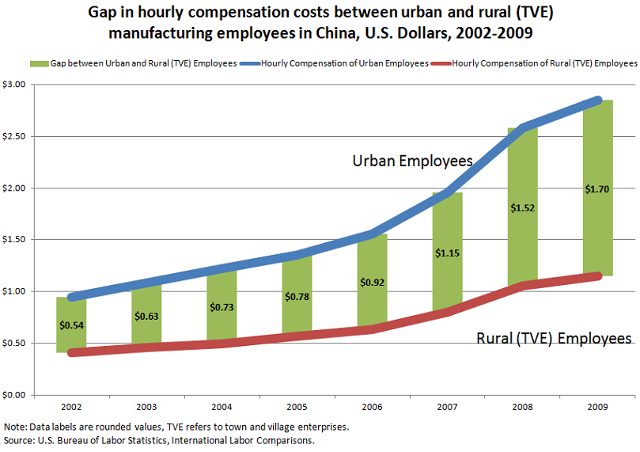
The bachelors in areas like Da Xin are the least likely of all to find love. As the gap between rich and poor widens in China, uneducated rural men have little means of upward mobility. “I don’t have any money to move away to look for a wife,” says Jin. “I must stay here to work our land and support my elderly mother.”

Think about these 30-something men (basically men my age) who work all day, not to come home to a wife or child (and a reason to get up everyday and go to work), but to their aging parents and grandparents. Knowing that the only way to change things is to abandon their family.
sn_china_paygap_rural_urban

Working Conditions
Some people do leave their villages and their families in the hopes of finding better jobs and better romantic prospects.

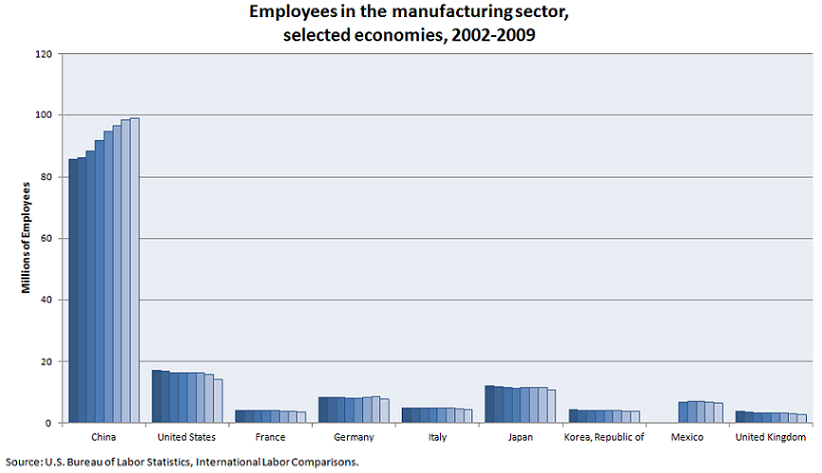
Manufacturing represents 44% of China GDP and is supported by an estimated 100 million workers. In the video above, you can see hundreds of people waiting outside the factory every day with the hopes of finding work inside the plants.

sn_china_employ_manufacturing

Once they do get jobs, employees might find themselves working 12 hour days, 6 or 7 days a week, and living in cramped dorm rooms.

The conditions became so bad at some factories that administrators had to put up nets to prevent employees from jumping off the buildings:

The Foxconn suicides occurred at the so-called “Foxconn City” industrial park in Shenzhen, China. The 18 attempted suicides by Foxconn employees resulted in 14 deaths—the company was the world’s largest contract electronics manufacturer at the time. The suicides drew media attention, and employment practices at Foxconn were investigated by several of its customers, including Apple and Hewlett-Packard (HP). Foxconn is a major manufacturer that serves high-profile consumer electronics firms such as Dell, Motorola, Nintendo, Nokia, and Sony.

Chinese workers are concluding that perhaps factory work is not for them and are shunning that life:

Finally, many first-generation migrant workers have worked in the cities for 10-15 years, yet they are still denied entitlement to any social benefits. While government policies now require employers to pay benefits for their employees, implementation is still at a primitive stage and differs vastly across the country. Naturally, migrant workers would prefer to work in regions where social-welfare policies are better implemented.

In addition to potentially poor and cramped working conditions, Chinese workers are also rejecting factory work due to the health issues…

Environmental Problems

Why has the rest of the world outsourced their manufacturing to China? Yes the labor is cheap and (mostly) abundant, but they are also very lax in their regulation of pollution.  Yes, our beloved gadgets are a result of some very toxic manufacturing processes.

So toxic in fact, that many employees have been poisoned:

In mid-July, Long found herself unable to move her legs. “I was just lying on my bed all day and needed help to eat,” she says. Long ended up in a hospital in Guangzhou with more than 30 other Fangtai Huawei workers. Doctors found they’d been exposed to n-hexane, presumably in the “banana oil.” It’s an industrial solvent that causes neurological damage at just 50 parts per million. Workers using it are supposed to wear respirators and operate in a ventilated area. As treatment, Long endured daily injections—she says they “hurt more than anything else in the world.”

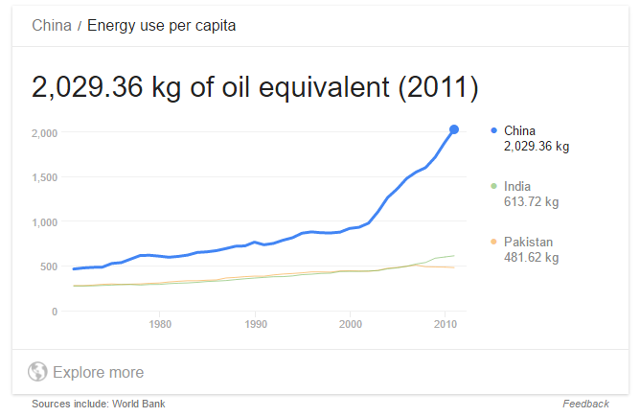
Not only does making the stuff cause pollution, but keeping the lights on at all of these manufacturing cities takes energy… lots of it.  And like many other countries (including the United States), China’s primary sourcing of energy is burning coal

sn_china_energy

Burning coal is dirty (as seen in the video above)

China’s apparent demand for crude oil will reach 550 million tonnes (11 million barrels per day) and apparent demand for natural gas will hit 205 billion cubic meters, Nur Bekri, head of the National Energy Administration (NEA), said, according to Xinhua.

Electricity consumption will rise to 5.7 trillion kilowatt-hours and coal consumption will be 3.96 billion tonnes.

Burning coal and running factories is such dirty business that China has a tendency to shut down production when visitors arrive. They shut down factories for the Beijing Olympics, and they are planning to do so again for the G20 Summit in September.

Since this is a supply chain focused webpage, I am curious to see how the supply chain will be impacted by this production shut down. If you think you could be impacted, check to see which of your suppliers (n-Tier) are receiving goods from the affected region (especially from chemical, electro mechanical, building material, and pharmaceutical industries).

Conclusion
This is not a condemnation of China. America has a long and horrible history of mistreating workers and our natural resources:
sn_cleveland_river_fire
Cuyahoga River Fire (Cleveland), 1952

In the coming years, Americans won’t be moaning about China taking their jobs, because the Chinese don’t want them. Those jobs will taken by automation and robots.

There is actually an opportunity for America to re-emerge as a manufacturing leader, but powered by the same robots and AI that will replace Chinese workers.

China is at a critical point in their own history: they have a massive population with needs that are going unmet and they don’t have the infrastructure in place to address those needs. Additionally, the poor treatment of their own natural environment is going to lead to even more medical and social distress.

As the country grows and becomes more connected with the rest of the world, the people who are making the stuff you love, are going to want stuff to love for themselves. It is already happening.

China is going to grow and evolve regardless of what I type here.  But will the country continue to be the hands and feet of the global economy or will they clean up their cities, open their borders (for workers and for brides), and create something new?

It is going to very interesting to see how this plays out.

Note: Here is the Fair Labor Report referenced in the video.

Photo: Travel Coffee Book

News You Can Use: 7/27/2016

sn_goldengate_Denys Nevozhai

  • What might Brexit mean for procurement?

    For example, if the UK followed the Norway model it would be a member of the European Economic Area (EEA) and remain bound by the EU procurement directives. By contrast, if the UK adopted something like the Swiss model of bilateral agreements with the EU (see here for more on the different models) then the EU procurement directives would not apply. However, the UK would very likely have an obligation under those bilateral agreements to put in place a similar regime.

    http://www.lexology.com/library/detail.aspx?g=d035f483-bccb-46dd-ae53-8858d4e8b222

  • How To Hold A Productive Meeting In Seven Minutes Or Less

    There’s no sitting down during these meetings; everyone stands up because it forces people to move and think a little faster, without the luxury of getting too comfortable. The best time of day to run these meetings is around 11:00 a.m. or 2:00 p.m., because this is when energy levels start to ebb. Part of your goal with a daily huddle is to boost those energy levels. You may even choose to run one from 10:55 a.m. to 11:02 a.m. and again from 1:55 p.m. to 2:02 p.m.

    Also:

    But there’s a formula that helps keep things brief and to the point. Every update is done the same way, and each business area answers the same questions:

    • What are you working on?
    • What were you working on last week?
    • What are you stuck on?
    • Is there anybody that you’re hiring?

    The next phase involves the team sharing any missing systems and venting their frustrations. This is a time for people to speak up about an area that’s apparently broken or where they’re stuck. Bear in mind, this is not the venue to solve the problem. This is the space for people to address the problems they face.

    http://www.fastcompany.com/3061605/your-most-productive-self/how-to-hold-a-productive-meeting-in-seven-minutes-or-less

  • One Googler’s Insider Guide To Using Google Docs At Work
    I didn’t know Google Docs could do Macros….#hyped

    TURBOCHARGE GOOGLE SHEETS WITH POWERFUL FUNCTIONS AND PIVOT TABLES
    Sheets is way more than just a way to throw a quick table or list together. It has over 340 powerful functions, including dozens that other spreadsheets don’t offer, such as Google Translate, which lets you automatically translate one language to another.

    We’ve also designed Sheets to offer advanced pivot table functionality, including the ability to define custom Calculated Fields. And Docs and Sheets both support custom scripting and advanced API functionality via Apps Script, which is Google’s equivalent of macros. Basically, if your job entails a lot of number crunching, Sheets can handle it.

    http://www.fastcompany.com/3061482/one-googlers-insider-guide-to-using-google-docs-at-work

    Yes.. the video is very wee (“let’s save the world!”), but the upvote question feature is on point.

  • Why this is a great time to be a supply chain professional

    Enterprise software that was traditionally installed, configured, and implemented behind the firewall resulted in a large amount of “shelf ware”. This was partly due to conflicting priorities on IT organizations wherein projects got deprioritized resulting in shelved software, and partly due to software vendors offering incentives towards bulk purchase of these modules which take years of implementation. This resulted in a significant gap between the capabilities vendors introduced to the market and the consumption of the same by the user community.

    However, “pay as you go” SaaS based delivery models are enabling companies to consume software in bite sizes and immediately start deriving value. SaaS delivery model is also easing the pain associated with upgrades. This goes a long way in ensuring user satisfaction. Satisfied users will demand and consume more innovation perpetuating a positive reinforcement cycle. This creates tremendous opportunities for supply chain professionals, especially those who like to explore newer frontiers.

    https://blog.kinaxis.com/2016/07/great-time-supply-chain-professional/

  • Strategically Discussing Strategy

    Strategy isn’t just doing more.
    Often, it means doing less. As Bob Shrum, Presidential campaign guru, once warned me “people in our business have a tendency to complicate common sense.” He was right. We throw in unnecessary processes, services that clients don’t need — all in the name of strategy. Harvard Business School’s Michael Porter said strategy is fundamentally about choices: You can’t be all things to all people.

    https://www.entrepreneur.com/article/278063

Photo: Denys Nevozhai