


Supplier Report: 3/4/2017

Amazon Web Services had a bad day this week, and when AWS has a bad day, so does the rest of the internet. AWS had a 4-hour outage on Monday caused by human error.  Later in the week, the company reported that they have put processes in place to prevent this type of issue from occurring again.

IBM is making news for gaining a patent for out-of-office email responses.  IBM then made news for being ridiculed for attempting to patent basic technology that has been around for over a decade. Big blue made news a third time for offering the patent up for public use.

Acquisitions

No acquisitions for two weeks in a row… 

Artificial Intelligence

Cloud

  • The day Amazon S3 storage stood still

    By now you’ve probably heard that Amazon’s S3 storage service went down in its Northern Virginia datacenter for the better part of 4 hours yesterday, and took parts of a bunch of prominent websites and services with it.

    It’s worth noting that as of this morning, the Amazon dashboard was showing everything was operating normally.

    Additional Background:

    Amazon S3 is used by around 148,213 websites, and 121,761 unique domains, according to data tracked by SimilarTech, and its popularity as a content host concentrates specifically in the U.S. It’s used by 0.8 percent of the top 1 million websites, which is actually quite a bit smaller than CloudFlare, which is used by 6.2 percent of the top 1 million websites globally – and yet it’s still having this much of an effect.

    Information on S3’s historical uptime:

    To provide some additional perspective, CloudHarmony, a service that tracks cloud outages reports that S3 has typically exceeded its Service Level Agreement (SLA), which promises that the service will be up 99.9 percent of the time and offers refunds for those times when it’s not. CloudHarmony found that in most cases S3 has achieved 100 percent annual availability since the company began monitoring cloud services in 2014. The notable exception was an S3 outage in August, 2015.

    https://techcrunch.com/2017/03/01/the-day-amazon-s3-storage-stood-still/?ncid=rss
    The root cause was human error

    Amazon apologized for the disruption on the AWS services page. It writes that a Simple Storage Service (S3) engineer was debugging an issue causing the S3 billing service to run slowly. They “executed a command which was intended to remove a small number of servers for one of the S3 subsystems that is used by the S3 billing process.”

    “Unfortunately, one of the inputs to the command was entered incorrectly and a larger set of servers was removed than intended. The servers that were inadvertently removed supported two other S3 subsystems. One of these subsystems, the index subsystem, manages the metadata and location information of all S3 objects in the region.”

    http://www.techspot.com/news/68381-cause-amazon-web-service-failure-resulted-parts-internet.html

  • AWS Taking On Microsoft, Google with Productivity Suite

    Sources told The Information that AWS is still in the early development stages with its productivity suite and hasn’t ironed out exactly what apps it would include. The company is reportedly working to upgrade its existing WorkMail and WorkDocs to appeal to more corporate customers.

    http://www.geekwire.com/2017/amazon-may-take-microsoft-google-new-aws-productivity-suite/

  • Box’s Levie touts positive cash flow

    The company celebrated its first quarter as a free cash flow (FCF) positive business, with CEO Aaron Levie characterizing this as an “inflection point” in a call with TechCrunch. FCF was $10.2 million for the quarter, which they say is a $30 million gain year-over-year.

    But Wall Street was disappointed that Box cautioned its first-quarter earnings would likely lose 14 to 15 cents per share, worse than the negative 12 cents investors are watching for.

    https://techcrunch.com/2017/03/01/boxs-levie-touts-positive-cash-flow/?ncid=rss

Datacenter

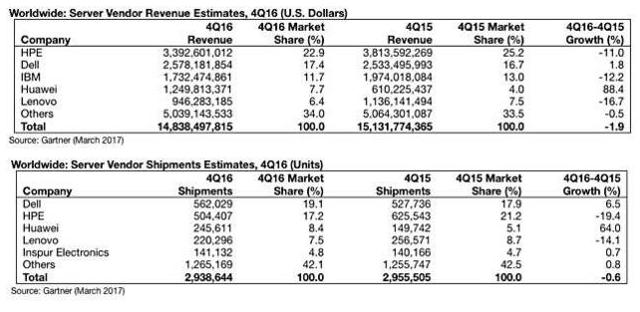
  • Why so sad HPE, IBM, Lenovo? Server sales? Let’s see… ah. Oh dear

    Overall, according to Gartner research VP Jeffrey Hewitt: “x86 servers continue to be the predominant platform used for large-scale data center build-outs across the globe, and the growth of integrated systems (including hyperconverged integrated systems), while still relatively small as an overall percentage of the hardware infrastructure market, also provided a boost to the x86 server space for the year.”

    https://www.theregister.co.uk/2017/03/02/server_market_shrinks/
  • IBM flash storage key to turnaround, says GM Walsh

    Look at how you use data to drive your business through better insights. Say you’re doing a poll to get some analytics. How do you run the poll? How do you tell the system, ‘Tell me … this answer,’ and then put some understanding around the answer. Cognitive is placing reason around the data so you understand it and get help with decision-making. Those applications takes a lot of CPU and memory, so flash media allows you to do those things better.

    http://searchsolidstatestorage.techtarget.com/news/450413920/IBM-flash-storage-key-to-turnaround-says-GM-Walsh

  • HPE’s struggles might have something to do with Microsoft

    While Microsoft has been deploying some white-box servers for years, the company seems to have stepped up its efforts lately. In October, the company unveiled Project Olympus, a design for modular servers featuring internally-designed motherboards and power supplies. Olympus is being contributed to the Open Compute Project (OCP), a Facebook-led initiative to create open-source designs for low-power data center hardware.

    https://www.thestreet.com/story/14015918/1/hp-enterprise-s-struggles-might-have-a-lot-to-do-with-microsoft.html

Software/SaaS

  • Zipnosis, PokitDok intertwine claims processing and telemedicine

    “PokitDok designed claims administration tools to support emerging digital health companies like Zipnosis,” said Lisa Maki, co-founder and CEO of PokitDok. “This engagement really hit our sweet spot: working to strip costs and unproductive time out of clinical visits. We leveraged our HIPAA-compliant data connections to health insurers and payers to facilitate this new workflow. The result is quality care delivery with improved efficiency.”

    http://www.mobihealthnews.com/content/zipnosis-pokitdok-intertwine-claims-processing-and-telemedicine

Other

Photo: AJ Montpetit

News You Can Use: 3/1/2017

  • Rough Day at Work? Exercise and Sleep Are the Best Ways to Shake It Off.

    They found that participants who took a daily average of 10,900 steps were less likely to take out their frustrations on their loved ones than those who took an average of less than 7,000 steps a day.

    The study also found that burning about 587 calories can translate to shaking off a tough day and stop an individual from bringing work issues home with them. The authors recommended activities such as walking and swimming.

    https://www.entrepreneur.com/article/289127

  • The Millennial CPO: How Will the New Generation Transform the Supply Chain Profession?

    “I envision the field to become more and more tech-centric,” says Jennifer Wolff, senior manager of material planning at Masco Cabinetry. “I continue to be disappointed by the systems that exist for our field.” It is safe to say that technology has embedded itself into the average millennial’s personal and work life. According to Nielsen, more than 85% of Americans between the ages of 18 and 34 own a smartphone, and a quarter of them ranked “technology use” as the defining characteristic of their generation.

    http://spendmatters.com/2017/02/15/millennial-cpo-will-new-generation-transform-supply-chain-profession/

  • How a Math Algorithm Could Educate the Whole World — for Free
  • 5 Steps to Develop a Supply Chain Risk Assessment Process
    1. Define stakeholder concerns
    2. Identify points of risk
    3. Develop a risk mitigation strategy
    4. Partner with third-party auditors and data collection agencies
    5. Simulate outcomes

    http://www.satprnews.com/2017/02/14/5-steps-to-develop-a-supply-chain-risk-assessment-process/

  • Oracle launches four apps for supply chain automation

    Nainani said Oracle’s supply chain and transport customers have “found it hard to adopt our IoT cloud components because they were uncertain how much investment was needed up front and how it would pay off for them.” In response, Oracle designed the new suite of tools to produce quick results in applications that clients are already using, Nainani said. The applications are in such areas as manufacturing, maintenance, customer service, and transportation management, he said.

    http://www.dcvelocity.com/articles/20170214-oracle-launches-four-apps-for-supply-chain-automation/

Photo: Alexander Mils

Supplier Report: 2/25/2017

The Healthcare Information and Management Systems Society (HIMSS) conference happened this week and featured IBM CEO Ginny Rometty as a keynote speaker. As IBM extolled the virtues of artificial intelligence, industry insiders are asking if it is too early for the healthcare industry to embrace it.

While IBM tried to highlight AI’s benefits, AWS announced even more healthcare-friendly cloud environments and offerings.

Acquisitions

There were no major acquisitions this week!

Artificial Intelligence

  • IBM’s Rossi on AI ethics: ‘Start small and widen the scope

    An example, she said, is the work IBM and other companies, together with domain experts, are doing on decision-making support systems in healthcare. The approach is to go from medical specialty to medical specialty, scenario by scenario. “We understand what we expect from that doctor, and we expect the AI system to behave at least as ethically as a doctor, if not better,” Rossi said.

    http://searchcio.techtarget.com/blog/TotalCIO/IBMs-Rossi-on-AI-ethics-Start-small-and-widen-the-scope

  • The robot that takes your job should pay taxes, says Bill Gates

    Gates said that a robot tax could finance jobs taking care of elderly people or working with kids in schools, for which needs are unmet and to which humans are particularly well suited. He argues that governments must oversee such programs rather than relying on businesses, in order to redirect the jobs to help people with lower incomes. The idea is not totally theoretical: EU lawmakers considered a proposal to tax robot owners to pay for training for workers who lose their jobs, though on Feb. 16 the legislators ultimately rejected it.

    https://qz.com/911968/bill-gates-the-robot-that-takes-your-job-should-pay-taxes/

  • Gartner Magic Quadrant Shows Microsoft Leading BI and Analytics Industry

    Kamal Hathi, GM for Microsoft BI, wrote in a blog post that Microsoft was able to achieve the recognition due to their customer-centric approach, regular development and ship cycles for Power BI. Microsoft also says that the development of Power BI was helped by high-value community feedback from more than 200,000 active participants submitting over 6000 ideas since Power BI’s July 2015 public launch.

    http://1reddrop.com/2017/02/18/gartner-magic-quadrant-microsoft-leading-business-intelligence-analytics-industry/

Cloud

  • Google’s new cloud service is a unique take on a database

    The service will be useful for companies that need millisecond-level consistency in their databases worldwide, according to Nick Heudecker, a research director at Gartner. In an interview, he called out financial services and advertising as two industries that might benefit from Cloud Spanner.

    Heudecker did point out that the service will require companies to port existing applications, which may prove challenging. Google is working with partners to help customers move over, according to Deepti Srivastava, the product manager for Cloud Spanner.

    http://www.cio.com/article/3169522/cloud-computing/google-s-new-cloud-service-is-a-unique-take-on-a-database.html

  • PokitDok, Merck, Orion Make AWS Announcements at HIMSS17

    Organizations looking to deploy third party software in their health IT infrastructure can now be sure that the solution will be compliant with the required healthcare standards. The category is made up of solutions that have been fully adapted to or built specifically for the healthcare and life sciences industries.

    AWS made this adjustment to its marketplace because of the unique requirements and environments of healthcare organizations. The amount of data collected by healthcare organizations makes them unique, and legacy systems simply can’t handle all the data coming in.

    http://hitinfrastructure.com/news/pokitdok-merck-orion-make-aws-announcements-at-himss17

  • NTT DATA and Oracle Corporation expanding relationship to include end-to-end cloud capabilities

    NTT DATA, Inc. announced the company’s existing relationship with Oracle Corporation is expanding to include end-to-end cloud capabilities for Oracle’s Healthcare Foundation, a unified healthcare analytics platform. The platform provides data integration and warehousing of clinical, financial, administrative and -omics modules in a cloud solution to customers worldwide. The healthcare cloud offering will provide organizations the ability to easily unify, grow or replace their existing healthcare data warehouse and data aggregation solutions. “This collaboration with Oracle will help healthcare organizations implement a cloud-based solution that will improve outcomes and deliver tangible business results,” said Dan Allison, president, global healthcare and life sciences, NTT DATA.

    http://www.benchmarkmonitor.com/2017/02/21/ntt-data-and-oracle-corporation-nyseorcl-expanding-relationship-to-include-end-to-end-cloud-capabilities/

Datacenter

Software/SaaS

  • SAP license fees are due even for indirect users, court says

    “Any business using SAP is now exposed to substantial SAP penalties and ongoing maintenance charges unless they obtain licenses not just for their internal users but also their customers and suppliers. The danger arises where there is any flow of data from the systems via customer portals to individual customers — even indirectly,” he said.

    “Although the ruling only has U.K. applicability, SAP’s license agreements are effectively harmonized globally; any corporate needs to take notice and see that SAP’s licensing reach goes far beyond use just within the internal business,” Fry said.

    http://www.cio.com/article/3170997/cloud-computing/sap-license-fees-are-due-even-for-indirect-users-court-says.html

  • There’s finally a commercial use for blockchain tech in finance

    According to Justin Chapman, Northern Trust’s head of innovation research, private-equity fund admin is currently a mess of paperwork that a blockchain platform will automate away. “It’s an extremely manual process at the moment,” he says. “It can take three to four months to agree on legal documentation for distribution. Now it can be done as soon as the lawyer gets to the paperwork.”

    Everything from share issuance to capital drawdowns and income distributions will be captured on the admin platform, Chapman says. But this can already be done with a conventional database or even a shared Excel spreadsheet, so why use fancy new tech? It’s because of blockchain tech’s secret sauce: trust. “Blockchain makes this immutable,” Chapman says. This means all the parties in a private equity deal can look at one version of transaction and other data, instead of trying to reconcile multiple copies of deal documents, which can be a laborious and error-prone process.

    https://qz.com/916601/northern-trust-and-ibm-announce-a-blockchain-for-private-equity-fund-administration/

  • NPR: Planet Money: Blockchain Gang

    Since we are talking about Blockchain – I listened to this podcast a few weeks ago and I think it does a great job of explaining what it is and the uses outside of bitcoin.

Other

  • Healthcare Information and Management Systems Society 2017: Ginni Rometty Keynote

    AI to define the future of healthcare, says IBM CEO

    Rometty revealed IBM will be focusing on cognitive computing over the next few years to transform precision medicine and personalised care; at the beginning of the year, IBM experts also said AI will transform the future of mental health care by analysing patterns of speech and writing to determine the best course of treatment:

    “What were once invisible signs will become clear signals of patients’ likelihood of entering a certain mental state or how well their treatment plan is working, complementing regular clinical visits with daily assessments from the comfort of their homes.”

    http://www.hitcentral.eu/british-journal-healthcare-computing/ai-define-future-healthcare-says-ibm-ceo
    HIMSS17: Artificial intelligence focus asks the industry – too soon?

    The healthcare industry has never been renowned for its speed of adoption, despite the big tech conferences showing off all their latest futuristic capabilities other industries adopted years ago. On one hand, it still seems like the industry hasn’t fully achieved the theme of last year’s conference: Interoperability. Many businesses have become profitable by providing add-ons to legacy EHR systems which can’t function the way many providers want them to. Some physicians have still yet to adopt using email to communicate with their patients. The use of AI and the like seems like a far leap in the face of the industry’s present technological infrastructure.

    http://www.healthcaredive.com/news/himss17-artificial-intelligence-focus-asks-the-industry-too-soon/436807/

  • Everything You Need to Know About Cloudbleed, the Latest Internet Security Disaster

    You might not be familiar with Cloudflare itself, but the company’s technology is running on a lot of your favorite websites. Cloudflare describes itself as a “web performance and security company.” Originally an app for tracking down the source of spam, the company now offers a whole menu of products to websites, including performance-based services like content delivery services; reliability-focused offerings like domain name server (DNS) services; and security services like protection against direct denial of service (DDoS) attacks.

    http://gizmodo.com/everything-you-need-to-know-about-cloudbleed-the-lates-1792710616

  • Hewlett Packard Enterprise slumps on poor sales, weak forecast

    HPE Chief Executive Meg Whitman said the company is dealing with “several factors” that are affecting its performance. Those include foreign currency exchange rates, increases in the prices of commodity technology products such as DRAM memory, and what appears to be a tough market for its main server and storage products among its core service provider and enterprise business customers.

    http://www.siliconbeat.com/2017/02/24/hewlett-packard-enterprise-slumps-poor-sales-weak-forecast/?doing_wp_cron=1487958276.0218529701232910156250

Photo: Alex Wong

AWS CEO Andy Jassy talks about competition

Amazon Web Services CEO Andy Jassy doesn’t talk much about the competition, but he made rare comments about that competition during a recorded chat with a college professor.

On IBM and Oracle:

“I think there’s a second category of large technology companies that just took an ungodly long time to get there. These are companies like Oracle and IBM, some of those folks. I think for them the model that we were pursuing, in the cloud, was so disruptive to their core businesses. The margin structures are radically different. The pricing structures are dramatically different. The delivery model is radically different. The way you take care of customers is radically different. So different that I think you have that dilemma at a lot of large companies: do you really want to try and accelerate the cannibalization of an existing … I think that they fought as long and hard as they could. They pooh-poohed it and they said, first no one will use it, then maybe only startups will use it, and they won’t use it for anything real, then enterprises will never use it, then enterprises will never use it for anything mission-critical. Companies and developers voted with their workloads, and so now they’re in this spot of trying to spin something up. It’s six, seven years late.”

Photo: Jaromír Kavan