SourceCast: Episode 59: Remote Possibilities


Procurement & Career Guidance

Organizations these days need more than traditional historically focussed spend analytics that tell them, weeks or months after, what was spent, on what, from whom, by whom, from where, to where, and in what quantity. You need to know what is being spent, by whom, on what in real time … and where the dollars are trending towards. Is a new supplier taking all of the spot buy spend, or even worse, spend that is supposed to be on another contract? Are product and services tastes changing? Are market costs changing? The application has to not only be able to keep up, but identify the most pertinent trends and options for dealing with them … it has to have advanced predictive analytics that, at the very least, identifies the most relevant changes (and ranks them by value or statistics or outlier distance from the expected norm), if not offering prescriptive analytics on how to take advantage of changes, minimize losses, or control them in (historically) well understood situations.
Procurement also brings market information (suppliers, price points, service levels) that IT may not be as focused on, but that could be critical to the overall solution. IT groups can at times limit themselves to certain suppliers for system or software solutions, but there may be alternate suppliers that easily integrate, or provide enough value to justify the effort required for working with disparate suppliers or systems. Procurement can bring that perspective forward and champion the needs of the business to balance the costs associated with IT change.
Levi’s has always been a leader in sustainability. In 1991, it established “terms of engagement” that laid out the brand’s global code of conduct throughout its supply chain. This meant setting standards for worker’s rights, a healthy work environment, and an ethical engagement with the planet. “It wasn’t an easy thing to do,” Dillinger says. “At the time, we were worried that doing this would drive up our own costs and prices.” In fact, what happened was that these practices were quickly adopted by other companies, who used it as a template to write their own rules. “We were actually leading industry toward new standards,” he says.
https://www.fastcompany.com/3067895/moving-the-needle/levis-is-radically-redefining-sustainability
It doesn’t matter how productive you are if no one enjoys working with you. Steve Nash, a former NBA player that the researchers found to be particularly valuable at making his teams better, was famous for constantly high-fiving his teammates. There’s never been a direct measure of a “high-five to productivity ratio,” but doling out praise and encouragement seems to be indicative of creating a high-quality team culture, which in turn increases performance.
http://www.thesimpledollar.com/dont-be-the-kobe-bryant-of-your-office/
Photo: Oliver Cole

It was an eclectic news week for IT suppliers. Microsoft cut their cloud prices for certain services and is also starting to protect customers against patent trolls, promising to assist small companies should a nonsense lawsuit occur.
Google found themselves in federal court being asked to provide the FBI access to emails. The company hoped to use Microsoft’s successful defense in a similar trail as grounds to drop the request, but it was denied. When Google isn’t in court, they are expanding the use of complex games to vet and teach their AI better ways to solve for problems.
Acquisitions
We know what you are thinking. This might be a good thing for IBM, but it might not be a good thing for Nvidia, Xilinx, and Mellanox, who are the key three hardware partners in the OpenPower consortium that IBM formed with the help of hyperscale datacenter operator Google back in August 2013. Fair enough. All three companies seem to be doing fine against their respective competition, and the OpenPower effort might be a tight enough coupling to get interesting and innovative systems to market. But, we might argue, this effort to build a flexible platform – for that is what the OpenPower consortium is ultimately about – could be significantly enhanced and accelerated by a tighter coupling of the core technologies created by all four of these companies. The fourth being, of course, the Power family of processors created by IBM, which would be married to Nvidia Tesla compute GPUs, Mellanox InfiniBand and Ethernet switching, and Xilinx UltraScale Virtex and Kintex FPGAs.
https://www.nextplatform.com/2017/02/07/case-ibm-buying-nvidia-xilinx-mellanox/
Artificial Intelligence
The findings are important as humanity releases multiple AI into the world. It’s likely some will clash and try to either co-operate or sabotage one another. What happens, for instance, if an AI is managing traffic flow across the city, while another is trying to reduce carbon emissions in the state? The rules of the “game” which govern their behavior then become vital. Setting parameters, and being mindful of other agents, will be crucial if we’re to balance the global economy, public health and climate change.
https://www.engadget.com/2017/02/09/google-deepmind-ai-cooperation-research/
Marking a major step forward for artificial intelligence (AI), Libratus, an AI developed by Carnegie Mellon University (CMU), has resoundingly beaten four of the best heads-up no-limit Texas hold’em poker players in the world in a marathon, 20-day competition.
After 20 days and a collective 120,000 hands played, Libratus closed out the competition Monday leading the pros by a collective $1,766,250 in chips.
Cloud
Schachter joined the Internet search giant in 2012 from Salesforce.com, according to his LinkedIn profile. Initially he worked on Google for Work, formerly the overall brand for Google applications and devices. It is now part of the Google Cloud group. Schachter was promoted to head Google Cloud’s sales effort two years ago.
According to that story, there was a sales reorganization earlier this year in which Schachter got responsibility for North America sales while another executive took on Europe and the Middle East.
The Redmond., Wash., software group dropped prices by up to 61% on some of its products, though other offerings will not carry a discount.
Microsoft, the second-biggest cloud infrastructure services vendor behind Amazon.com Inc., will help customers fight back by offering them one of its own patents to deter or defeat such suits. The software giant will also expand a program in which Microsoft provides funds or legal resources to fend off claims, known as indemnification.
http://talkincloud.com/cloud-computing/microsoft-adds-patent-suit-protections-cloud-customers
Datacenter
In the new program channel partners will see rebate increases, Cook said. “There is no question rebates will be going up. If you look at the earnings opportunity for a Titanium partner who’s focused on storage they’ll get a base rebate of four per cent. Last year in the EMC plan alone it was two per cent. If you grow past the growth target…say $20 million…now they’ll make 10 per cent. Include some services and you get an additional one per cent. If it’s a new logo sale add another eight more points,” she said.
Management at the facility addressed the 500 staff there this morning in relation to its future and said that the plant is to close before 2018 with all 500 jobs gone.
Software/SaaS
Open source won. It won because it’s used everywhere now. But now we have a supply chain problem we need to start thinking about and that is, where did you get it and how is it being taken care of, because software doesn’t age well. This is something that you have to take care of and you have to pay attention to. You can’t just pull software into your project and you’re done.
http://www.cio.com/article/3167527/linux/open-source-users-its-time-for-extreme-vetting.html
Other
According to sources, the six “strategic” offices US marketing staff must work from are in: Austin, Texas; San Francisco, California; New York City, New York; Cambridge, Massachusetts; Atlanta, Georgia; and Raleigh, North Carolina. El Reg understands that employees will not get to choose a nearby office, but will instead be assigned a location based on where their team is predominantly situated. The first wave of workers were informed of the changes on Monday. The next wave will be instructed in early March, we’re told.
https://www.theregister.co.uk/2017/02/08/ibm_no_more_telecommuting/
The ruling is notable because it goes against an appeals court judgement last year — recently upheld — pertaining to Microsoft customer data held in servers outside the US. In that instance a federal court ruled the company did not have to hand over data stored on its servers in Ireland to the US government, declining to “disregard the presumption against extraterritoriality,” as the judge put it.
In a joint submission Wednesday to the U.S. District Court for the Northern District of California, lawyers for Oracle and the former employee Svetlana Blackburn asked for the vacation of a case management conference scheduled for Thursday, while submitting a notice of settlement to notify the court “that the lawsuit has been settled in principle, and to request thirty (30) days in which to file a dismissal.”
Photo: Oliver Cole


Note: This blog is apolitical and I will do my best to keep this post free of spin and stick to the facts.
During my research for last week’s supplier report, it was clear that President Trump’s immigration policies were a major pain point for IT companies. It was such a reoccurring thread that I felt I needed to go deeper to better understand the situation.
On January 27th, 2017 Donald J. Trump released an executive order that modified travel rights into the United States from several countries.
The executive order imposed a 90-day travel ban on the citizens of seven predominately Muslim countries: Iraq, Syria, Iran, Sudan, Libya, Somalia and Yemen. It also suspends the U.S. Refugee Admissions Program for 120 days. Additionally, it indefinitely prohibits Syrian refugees from entering the U.S.
As of February 5th, the Department of Justice is blocking the President’s executive order:
The US Justice Department filed an appeal just after midnight Sunday, asking to pause a sweeping decision from the judge that temporarily halted enforcement of several key provisions of President Trump’s executive order.
The status of the executive order has fluctuated during last week, and it is clear that President Trump is planning to fight this most recent setback:
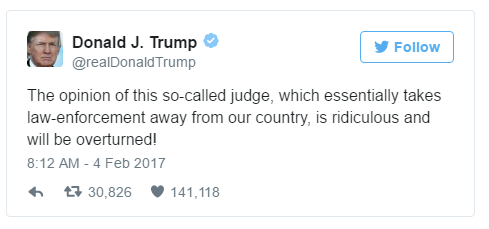
Trump’s modification of immigration policy has many in the technology industry concerned that the order was just the first step of more sweeping immigration reforms. It is being reported that the Trump administration is also drafting modifications to the H-1B visa program.
The US H-1B visa is a non-immigrant visa that allows US companies to employ graduate level workers in specialty occupations that require theoretical or technical expertise in specialized fields such as in IT, finance, accounting, architecture, engineering, mathematics, science, medicine, etc.
The program allows for 65,000 (+20,000 additional IT workers) into the country annually. Depending on the country, a worker can stay in the United States for 3 years with an option for an additional 3 year renewal.
Although there are annual controls on who is accepted into the via program, there doesn’t seem to be precise records on how many people in total are currently working in the U.S. under the H-1B visa program. It is estimated to be between 650,000-850,000.
White House press secretary Sean Spicer said the possible executive order on work visas “is part of a larger immigration effort” and stems from “an overall need to look at all of these measures.” C-level executives from many of the large technology firms have denounced this activity:
Microsoft CEO Satya Nadella:
“There is no place for bias or bigotry in any society, in any context. That’s where we start from,” Nadella told employees. “It is the enlightened immigration policy of this country that even made it possible for me to come here in the first place, and gave me all this opportunity.”
Google Co-Founder Sergey Brin:
“I think it’s important to not frame this debate as being ‘liberal’ versus ‘Republican’ and so forth,” Brin told the crowd. “It’s a debate about fundamental values, about thoughtful policymaking and many of the other things that I think are — apparently not universally adored — but I think the vast majority of our country and of our legislators and so forth support.”
Apple CEO Tim Cook sent an email to employees (and has not yet publicly commented):
There are employees at Apple who are directly affected by yesterday’s immigration order. Our HR, Legal and Security teams are in contact with them, and Apple will do everything we can to support them. We’re providing resources on AppleWeb for anyone with questions or concerns about immigration policies. And we have reached out to the White House to explain the negative effect on our coworkers and our company.
As I’ve said many times, diversity makes our team stronger. And if there’s one thing I know about the people at Apple, it’s the depth of our empathy and support for one another. It’s as important now as it’s ever been, and it will not weaken one bit. I know I can count on all of you to make sure everyone at Apple feels welcome, respected and valued.
Perhaps the Trump administration’s investigation and overhaul of the H-1B program is due to accusations of companies abusing the program. For example, Disney has been accused of laying off qualified domestic workers in favor of cheaper H-1B workers coming from India.
While the argument is being made that American interests are being protected by these measures, there is concern that by increasing the wage requirements for H-1B workers and making it more difficult to get these resources, US companies will just shift the job entirely to cheaper labor markets like India:
India’s technology companies, led by Tata Consultancy Services Ltd, Infosys and Wipro, have argued they are helping corporations become more competitive by handling their technology operations with specialized staff. They also contend the visa programs allow them to keep jobs in the U.S. and that if they have to pay more for staff, they will handle more of the work remotely from less expensive markets like India.
This is (clearly) a complicated issue that only gets more complex through a political filter. It seems possible that the H-1B program has been abused in the past and it is alarming that there isn’t precise documentation on how many people are working under the program currently.
The United States is a country that was forged through immigration and there are many examples of people coming here with nothing and creating companies and jobs. Turning away from that cultural identity can be damaging and have long lasting impact.
Photo: Ferdinand Stöhr