SourceCast: Episode 54: Predictions

Procurement & Career Guidance

According to Steve Polski, senior director of responsible supply chains and sustainability at Cargill, consumers consistently say they want more sustainable products and services but are often unwilling to pay a premium. Polski has spent years researching this topic, and he has found that consumers care about a company’s sustainability and ethical sourcing efforts and may reward it with brand loyalty, but they generally don’t want to pay more for the products.
Also:
The survey also found just how much consumers said they were willing to pay for ethically and sustainable sourced products. Thirty percent said they would pay up to 5% more and 28% said they would pay up to 20% more for such products. A quarter of consumers also said they actively sought sourcing origin information when they made their most recent purchase.
The Science of Us explains that, like most people, when you feel powerless or helpless, your first instinct is to exert control over the things you do have some control over, and if you’re a boss or manager, that might mean your employees. While we know that most people work best when they’re given independence and autonomy, and when managers trust their teams to make the best calls when they need to, well, sometimes good old psychology just takes hold.
http://lifehacker.com/why-your-annoying-boss-micromanages-you-1790380406
China isn’t the only Asian country Apple could continue to work with. The Wall Street Journal reported that it may manufacture products in India and could be currently working toward a deal for this with the Indian government.
However, this seems to be more of a matter of speculation and deduction than pure fact, since Apple did not comment and Tim Cook, the company’s CEO, openly said that there were no plans to start producing in the country earlier this year.
Forbes contributor Tim Worstall also pointed out that most of the benefit would go to Apple, with the Indian economy itself not gaining too much from the company’s presence there. This sits in contrast to Apple’s work in China, which also benefits the country in addition to the business’ sales themselves.
http://www.strategicsourceror.com/2016/12/3-predictions-for-apples-supply-chain.html
Stop acquiring companies and products just to kill them:
Some of the greatest apps and sites ever created were acquired as they were rising in popularity, then terminated. Remember Posterous, Pownce, Dodgeball, reMail, Nextstop and Friendfeed? These were all innovative, powerful, well-designed apps or services that were terminated on purpose because they were so good.
Photo: Anchor Lee

Alas… the last supplier report of the year.
We had an insane year of M&A and corporate entity disintegration (I am looking at you HP). AI is getting popular not only in enterprise but also in your home thanks to Amazon and Google. Cloud continues to expand in function and use and AWS is the uncontested champ in 2016.
Year-end news cycles dictate a deluge of retrospective and predictive slop. Who am I to reject this time-honored tradition? Prepare yourself for a summary of summaries!
Acquisitions

Artificial Intelligence
As they push this technology into their own products as services, the giants of the internet are also pushing it into the hands of others. At the end of 2015, Google open sourced TensorFlow, and over the past year, this once-proprietary software spread well beyond the company’s walls, all the way to people like Amanda Hodgson. At the same time, Google, Microsoft, and Amazon began offering their deep learning tech via cloud computing services that any coder or company can use to build their own apps. Artificial intelligence-as-a-service may wind up as the biggest business for all three of these online giants.
https://www.wired.com/2016/12/2016-year-deep-learning-took-internet/
The technology that has long been aimed at replicating human intelligence now seems to be paying attention to human patterns and behaviors. Recent advances in deep learning have enabled that kind of insight, but it’s not limited to beating humans at games. In 2016, AI broke out of the confines of research labs to transform the way we live, communicate and even conserve the planet. Chatbots popped up in group texts. Personal assistants invaded our homes. Cognitive systems are detecting cancer. Bots are writing movie scripts. And car makers are gearing up to unleash a bevy of autonomous vehicles onto public roads.
https://www.engadget.com/2016/12/25/ai-was-everywhere-in-2016/
To improve training with synthetic image data, the paper suggests what the Apple researchers call Simulated+Unsupervised learning, where the realism of a simulated image is boosted. The Apple researchers use a modified version of a new machine learning technique called Generative Adversarial Networks, which pits two neural networks against each other and has been used to generate photorealistic images.
The MERA uses IBM’s Watson AI to provide assistance to the elderly and monitor vital signs and environmental changes in a non-invasive manner.
IBM Research also plans to work with Sole Cooperativa, a healthcare provider in Italy, to install sensors in senior housing communities to monitor day-to-day activities of residents.
http://www.nasdaq.com/article/ibm-working-on-robot-to-help-elderly-20161228-00307
If only IBM can create a robot to help an elderly bank robber make one last score…
Cloud
In addition, Smith points to IBM’s 2015 acquisition of Explorys, a population health analytics vendor, which was developed by Cleveland Clinic physicians and IT experts before becoming a spin-off company in 2009—as an example of the technological cross-pollination between the two organizations.
“It’s been a mutually beneficial relationship. We’re creating value for each other,” concludes Smith. “That’s the kind of partnership it has been, and it will continue. The sky’s the limit.”
http://www.healthdatamanagement.com/news/cleveland-clinic-ibm-bolster-technology-partnership
Datacenter
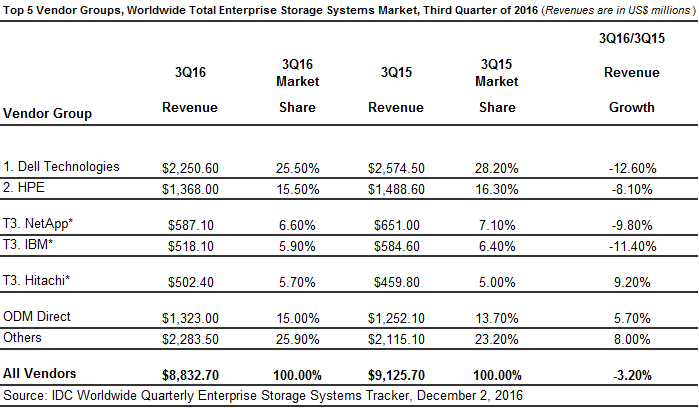
The storage market is too competitive to support new entrants unless they can truly disrupt the competition and industry. For the reasons explained above, we believe PSTG is doing just this and is hurting NMBL, EMC and NTAP. NMBL is growing, but is facing intense competition as described earlier and we don’t believe it will become profitable and independent. NMBL will struggle.
We believe PSTG is strengthening its competitive position and is consistently rolling out new products such as M10 and FlashBlade to provide a consistent increase in its TAM. This continuous strengthening of its competitive position and innovation gives PSTG a real chance to succeed. Success means independent and profitable.
http://seekingalpha.com/article/4032940-pure-storage-best-house-worst-street
Software/SaaS
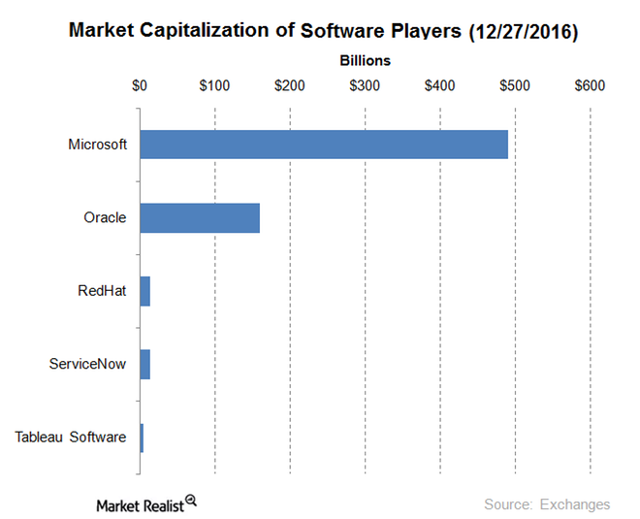
As of December 27, 2016, Microsoft (MSFT) continued to be the world’s largest software player by market capitalization, followed by Oracle, Red Hat (RHT), ServiceNow (NOW), and Tableau Software (DATA).
http://marketrealist.com/2016/12/oracles-value-proposition-software-space-5/;
Other
And this year’s IPO class raised just under $19 billion, the smallest amount since 2003, when 68 companies brought in a combined $15.2 billion, Renaissance reported.
The effect was felt strongly in Massachusetts, where a dozen companies held IPOs, just two of them from the state’s important tech sector. It was the lowest tally for Massachusetts since 2012, when nine companies went public, Renaissance said.
Larry Ellison often topped the charts of the highest paid tech CEOs. Now his successors – who made $53 million last year – share the distinction of the highest paid tech CEO. Hurd is the former Chairman, Chief Executive Officer, and President of Hewlett-Packard. As Oracle’s co-CEO, he received a 41% raise in 2015, driving the value of his pay package to $53.2 million. Nearly all of Hurd’s compensation came in the form of stock and option awards valued at $52.3 million.
Catz is an Israeli-born American, who joined Oracle Corporation in 1999. She is credited for having driven Oracle’s efforts to acquire software rival PeopleSoft in a $10.3 billion takeover in 2005. Like her co-CEO, Catz received a $53.2 million pay package – up 41% from $37.7 million in the previous year – that consists nearly entirely of stock and option awards (with the exception of a $950,000 salary and miscellaneous perks.)
http://www.cxotoday.com/story/the-highest-paid-tech-ceos-of-2016/
A writer for Equities.com – a financial website that accepts submitted articles from users – on Monday predicted Microsoft’s recent LinkedIn acquisition will propel the company to become the first to reach a $1 trillion market capitalization. Michael Markowski wrote in a widely reported post on the website that Microsoft will reach the milestone largely because of the applications for LinkedIn in the online equity crowdfunding space.
http://www.bizjournals.com/seattle/news/2016/12/27/amazon-microsoft-first-trillion-dollar-tech.html
First and foremost, Microsoft, under Satya Nadella—who stepped in as chief executive, replacing Ballmer about three years ago—must prove it can do big acquisitions well. Microsoft’s record there is checkered following misfires with Nokia and aQuantive—both purchases resulting in huge write-offs. That means all eyes will be on how the software giant does with its just completed $26 billion purchase of LinkedIn.
Photo: Chris Lawton