Wood takes a structured approach to mentoring. He and his senior team meet regularly to identify high potential people who, with the right coaching, could advance to the next stage in their careers. “Whether they are on a technical or a management track, we identify those people who are doing well in their current jobs, but could also do a job one or even two levels up,” says Wood. “We put those people into a formal mentoring program, but we also make it clear that if anyone else wants to be a part of the mentoring program, all they have to do is raise their hand.”
The point is, you can be the nicest guy in the world who treats his employees like gold. But, if you and your team are not cutting it in the eyes of your company and its stakeholders, I don’t care how likable, friendly, giving, sharing, approachable, communicative or empathetic toward your employees you are, you’re still a lousy boss.
If, on the other hand, you challenge your employees to excel at their jobs and lead your team to exceed expectations on a consistent basis, you’re probably well on your way to becoming a great boss.
We ourselves have written thousands of presentations and business documents in our careers. And, in our experience, the most important step is what we call “hanging the document.” In simple terms, you need an outline. However, this can’t be just a list of random points. The document has to have a structure. It has to hang together in a way that makes your point as clearly as possible.
4 reasons why nobody is looking at your presentation
When you deliver a presentation in the form of a story, it becomes more relatable and helps your audience develop an emotional connection with the material. This in turn coaxes memory into action. What’s more, using images to metaphorically support the story you’re telling can reinforce that effect even further. When your listeners feel connected, they’re not only more likely to remember, they’re more likely to take action.
Why Visionary CEOs Never Have Visionary Successors
After running Microsoft for 25 years, Bill Gates handed the reins of CEO to Steve Ballmer in January 2000. Ballmer went on to run Microsoft for the next 14 years. If you think the job of a CEO is to increase sales, then Ballmer did a spectacular job. He tripled Microsoft’s sales to $78 billion and profits more than doubled from $9 billion to $22 billion. The launch of the Xbox and Kinect, and the acquisitions of Skype and Yammer happened on his shift. If the Microsoft board was managing for quarter-to-quarter or even year-to year-revenue growth, Ballmer was as good as it gets as a CEO. But if the purpose of the company is its long-term survival, then one could make the argument that he was a failure as CEO, as he optimized short-term gains by squandering long-term opportunities.
Cloud providers are growing fast, but nobody is growing faster than Amazon. Such growth requires power, and Amazon is following in Google’s footsteps in trying to convert to all renewable energy.
Google combined their renewable energy goals with their AI systems to gain efficiencies, and the whole situation is reminding me of the not-so-great Johnny Depp movie Transcendence (the AI creates an awesome solar farm so it can’t be cut off).
While Amazon figures out their power needs, Microsoft is trying to take down the communication hub site Slack with their new Teams offering. Dell is also improving their document management applications… right before they sell them off to OpenText?
Acquisitions
CenturyLink to Buy Level 3 Communications for $25 Billion
Level 3 runs one of the largest internet backbones in the world but has turned its focus to small and midsize business customers to reverse slowing sales growth in its core operations. CenturyLink, traditionally a rural phone company, has sought to upgrade its network with fiber-optic lines in a bid to compete with AT&T Inc.,Verizon Communications Inc. and rivals in the cable industry.
IBM buys Expert Personal Shopper from Fluid to build out Watson’s conversation skills
IBM has made another acquisition to beef up Watson, a week after it announced a raft of new features and milestones for its artificial intelligence effort: it has acquired a business called Expert Personal Shopper (XPS), a platform, and bot, that holds conversations with people online to help figure out what they need to buy, and to help them buy it. XPS had originally been built by Fluid, a strategic partner (and investment) of IBM’s, to run on Watson.
Shares are now down more than 11% Wednesday. The M&A catalyst has been removed, and while Tableau beat on earnings-per-share estimates, its sales results missed expectations. Simply put, the company didn’t close enough deals during the quarter to make the results compelling. It was a letdown, Cramer concluded.
Furthermore, Tableau is not a potential acquisition target for Salesforce at this time, Cramer added.
IBM Introduces New Watson Solution for Supply Chain Professions
Part of IBM’s new cognitive solutions for supply chain professionals, IBM Watson Supply Chain Insights, continuously learns about a company’s normal supply chain patterns by analyzing and spotting trends in the data from multiple systems including trade partners, which can account for up to 65 percent of the value of a company derives from its products and services. The solution then alerts practitioners to potential disruptions, provides insights into estimated time delays and financial costs of the issue and recommends specific experts who can gather in a virtual workroom to quickly solve the problem.
There are currently 3 billion people online, but due to dropping bandwidth costs and private investors building satellite networks, low estimates project 6 billion people online by 2020.
Peter talks about Moonshots: A moonshot, in a technology context, is an ambitious, exploratory and ground-breaking project undertaken without any expectation of near-term profitability or benefit and also, perhaps, without a full investigation of potential risks and benefits.
Diamandis wants to increase the average human lifespan by 30 years. AI (Watson) is a huge part of that goal as it can analyse data from genome sequencing, advanced diagnostics, and providing medical care in remote areas without doctors.
He wants to mine asteroids for resources (platinum) and fuel. His company is building rockets (Arkyd Spacecraft) to prospect asteroids. These ships will have AI (of course).
Wants basic software to be able to teach children to read in the most remote areas with simple devices (there are current 1 billion illiterate people on the planet).
Cloud
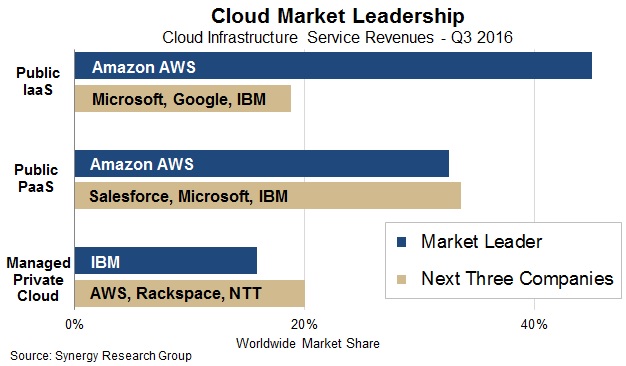
AWS Accounts for 45 Percent of Public IaaS Market Share: Synergy
Amazon Web Services (AWS) has a 45 percent share of the worldwide public cloud market, more than twice the size of the next three public IaaS providers combined, according to new data from Synergy Research Group.
Amazon orders new wind farm in Ohio to help power cloud business
Amazon Web Services, as the tech giant’s cloud computing division is known, has vowed to fulfill at least half of the energy needs of its big data centers with renewable energy by 2017. That’s up from 40 percent in 2016, a goal that Amazon says it is on track to meet or exceed.
‘In November 2014, AWS shared its long-term commitment to achieve 100 percent renewable energy usage for the global AWS infrastructure footprint. Ambitious sustainability initiatives over the last 18-24 months have put AWS on track to exceed its 2016 goal of 40 percent renewable energy use and enabled AWS to set a new goal to be powered by 50 percent renewable energy by the end of 2017.’
A peek inside Microsoft Azure’s open-source server and rack designs
“With this announcement you have one of the industry’s leading cloud providers sharing what they think the optimal cloud server design looks like,” says Ed Anderson, Research vice president, Cloud Services at Gartner. “Microsoft is deploying servers based on OCP in their cloud data centers, which provides a pretty good guide for hardware vendors to target that market.” Microsoft says about 90% of servers it buys for Azure data centers are based on OCP specifications.
Is HPE ditching OpenStack? Company laying off a number of developers
The layoffs in the Stackato may indicate HPE is further retreating from the ultra-competitive cloud market amidst tough competition from AWS and Microsoft. Last year, HPE pulled the plug on its Helion hybrid cloud offering. In August, Bill Hilf, HPE’s current cloud leader, announced he was leaving the company to “pursue other opportunities.”
Microsoft Takes Apple by Surprise, Pours on the Heat
One of the things that may have assisted in this assessment was the Surface Dial (US$99) which, on the surface, has the instinctive technical feel of something from a science fiction future in contrast to Apple’s touch sensitive Touch Bar which is merely cool. (But see page 2 here for more.) Time will tell if Microsoft’s instincts prove superior or are simply a trade-off in concepts. In the meantime, Jason Snell at Six Colors looks at the relative merits of touching your work or touching the Touch Bar in “Perpendicular philosophy.”
The company said in regulatory filing on Thursday that it would lay off 6% of its workforce, or about 640 employees based on its total headcount of 10,700 workers.
Dell EMC Sweetens ECD Products Before OpenText Acquisition
Today at Momentum — Dell EMC’s ECD user conference in Barcelona — the company unveiled long sought solutions around its three primary products: Documentum, InfoArchive and LEAP.
About a week after closing on its purchase of EMC, Dell signed a definitive agreement to sell ECD to OpenText. That acquisition is expected to close in early next year.
So all these new capabilities — many of which customers have been pleading to have for years — will benefit OpenText.
Slack’s freemium model also puts these tools in the hands of small businesses, giving them a free taste with the option to pay for advanced features. The fact that Microsoft Teams is tied to Office 365 means it will struggle to win over some small operations, but its tight integration with the Office suite might tempt larger businesses to defect from services like Slack.
Software licencing gets easier in the cloud? Not if your name is Microsoft
Features and functionality have been added to Plan 1 – including PowerApps that lets users create custom-made business apps – but if a customer doesn’t need them, then the price of their software has ramped massively, channel folk claimed. Depending on what employees were using, they may now pay more. Power users may actually pay less.
“There isn’t a direct one-for-one ratio, so Microsoft can wheedle out of it and tell customers they are getting more features. This is the challenge of explaining this to customers who want to know, ‘How do I get what I’m getting today and pay the same?'” a Microsoft supplier said.
Amazon posts disappointing Q3 results, but AWS continues to grow
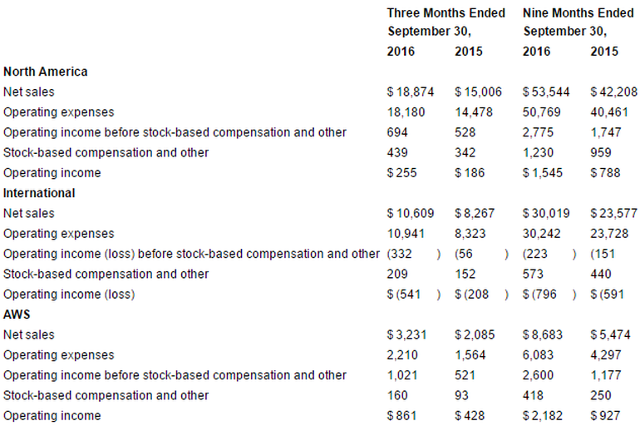
Amazon Web Services earned $3.231 billion in revenue, up nearly 55 percent year-over-year. Its operating income came to $861 million — more than three times the operating income of Amazon’s North American e-commerce business, which came to $255 million. Meanwhile, its international business lost $541 million.
IBM has hired more than 100,000 new IBMers since January 2015, cloud advisors, digital representatives, data scientists, etc. This includes about 700 executives (not including acquisitions).
IBM’s hiring spree follows a massive shift of resources from traditional computing business to the emerging cognitive business. This includes what the company invested in in terms of CAPEX, R&D (which is up this year) and acquisitions (26 since the beginning of 2015). It also includes significant investments to amass the skills most valued by the market as the company pioneers new fields such as Cognitive and Cloud.
Google reveals dangerous Windows 10 bug – and Microsoft is NOT happy about it
Google has incurred the wrath of fellow tech megacorp Microsoft by publicly flagging up a flaw in Windows and claiming hackers are exploiting it.
The search giant says it told Microsoft about the bug back on October 21, but as yet nothing has been done about it.The bug itself is found in the Windows kernal and can be used “as a security sandbox escape.”
Microsoft, in turn, has issued a statement to tech site Venturebeat , saying that Google is putting customers at risk.
Data caps are becoming the norm, and that’s very bad news for consumers, who increasingly choose to stream video instead of paying exorbitant fees for pay TV. No other reason exists to impose such caps than the desire to increase profits. Here’s how Comcast justifies its data caps: “Our data plans are based on a principle of fairness. Those who use more Internet data, pay more. And those who use less Internet data, pay less.”
Sounds fair … except it isn’t true. Unlike wireless providers, broadband ISPs have capacity to spare, and Comcast admits as much. In a memo leaked last year, Comcast told its sales people that data caps were not related to network congestion.
How To Tell Your Boss You’re Completely Overwhelmed
Feeling like you’re personally contributing, connecting with others, leveraging your creativity—or whatever your role means to you—is an anchor for the work you do. It’s why you do what you do. Without personal meaning, you’ll start to wear down from relentlessly throwing yourself into the churn and pulse of things. You can’t sustain this kind of disconnected, meaningless work for very long.
Are We Solving the Right Problem with Supplier Risk Management?
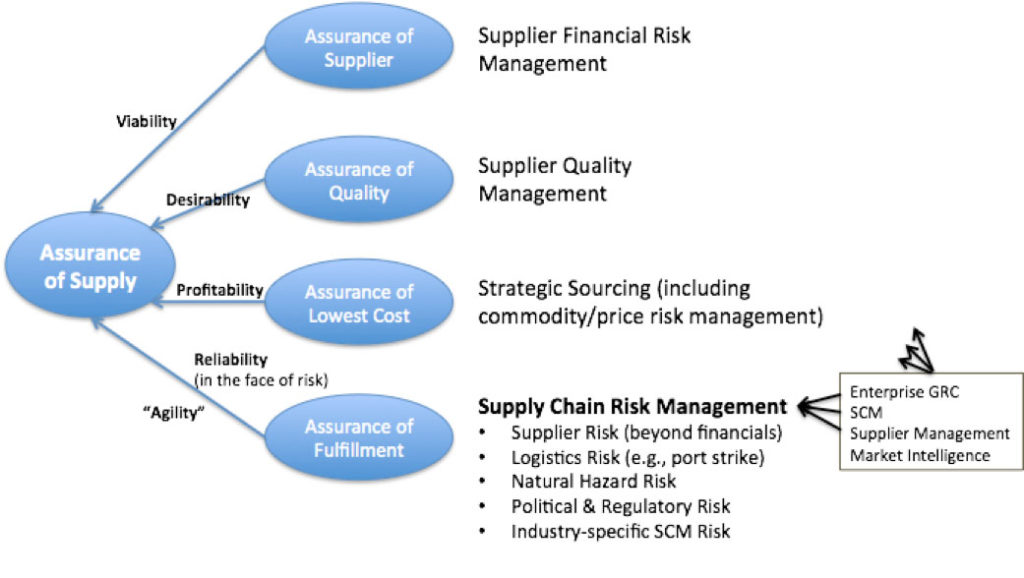
An agile supply chain means that you can be reliable even though an increasing number of things are going wrong. You can only do this if you can avoid those things in the first place or recover from them when they happen. Either way, this requires supply chain risk management, not just supplier risk management, and certainly not just supplier viability management via financial statement monitoring.
A Tour of WeWork’s New Coworking Space in Philadelphia
The office space is just minutes away from the Old City District, the home of Independence Hall, the Liberty Bell, and many other historical landmarks. The Market-Frankford Line has a stop on Girard Avenue, a five-minute walk from the office. There’s also a parking lot located diagonally across the street. Attracting a wide range of businesses, this Philadelphia office space is a great option for artists, designers, and other young entrepreneurs, as well as corporations looking for a local base of operations”, says WeWork
IBM had a big week due to their World of Watson conference. As one would imagine, an event called the World of Watson was heavily focused on AI and how it will integrate into our lives. They also used the event to announce the acquisition of another cloud-focused company. But IBM better watch out because Google’s Deepmind created an encryption protocol by itself.
There was also an OpenStack conference this week for cloud services. The event tested the ability to easily switch between 16 different cloud providers.
IBM announced it was much cheaper to support Macs over Window machines (which is actually old news), but Microsoft introduced some beautiful new desktops.
Acquisitions
IBM To Acquire Sanovi Technologies For Hybrid Clouding
The announcement for the procurement event held on October 27, 2016, carried off with a deal which would help IBM to enhance its elasticity capabilities. It would further support to meet the complexities of the hybrid environment through advanced analytics. The following deal would help IBM to boost its Software Defined Resiliency strategy, delivering Business Continuity, along with providing Disaster Recovery services for its clients who are in the middle of hybrid and digital cloud transformation.
US software giant IBM on Thursday announced that it has signed a deal to acquire Bengaluru-based Sanovi Technologies for an undisclosed sum. The deal would enable IBM to bolster its Software Defined Resiliency strategy, delivery of Business Continuity and Disaster Recovery services for clients who are undergoing digital and hybrid cloud transformation.
AT&T’s deal values Time Warner at 22 times the cash it generated from its operations. That seems high. When Comcast bought NBCUniversal in 2013 it paid around 8 times operating cash flow. WhenVerizon bought AOL in 2015, a number of commentators suggested that it had paid through the roof for the former Internet whiz kid. But even in that deal, Verizon only paid about 9 times AOL’s adjusted operating income.
Who, if anyone, will blink? NetSuite’s weak quarter make it decreasingly likely that Oracle’s Larry Ellison will blink first. As for T. Rowe, they might not either. They opposed the Dell LBO and intended to vote against it (their shares were mistakenly voted for it, so perhaps they will tender to Oracle by accident). But with no available alternative to realize more value than the current deal, both NetSuite and T. Rowe holders will quickly regret it.
Oracle CEO Hurd Says NetSuite Deal ‘Done from Our Perspective’
“Well it’s done from our perspective. We had special boards, special committees of both boards negotiate the transaction. We think we’ve made a fair offer of $109 a share,” he said.
The World of Watson
Talking points from the 2 hour video:
Watson will be almost everywhere in 5 years. It will be in doctors offices and assist companies with M&A (it will have profiles on every company on the planet).
John Kelly predicts that due to Watson’s modeling abilities, it will be able to predict future events in medical applications.
Tom Friedman states that 2008 was a milestone year in technology, in part due to Watson and the advent of cloud technology (high speed internet, cheaper storage) and we missed it for what it really is and society has been stuck not taking advantage of it.
Due to this technology, human interaction and sharing ideas has never been higher and the potential for quicker social change is more possible.
Friedman goes down an interesting path of how people (not nations) have the ability to destroy and also repair everything (you just have to watch it).
The video then shifts to new speakers doing their best Steve Jobs impressions talking about managing data via AI (nothing we haven’t discussed here already).
IBM, Teva to Use A.I. for Drug Repurposing Program
First, the companies formed a three-year research collaboration aimed at using human input, real-world data, and machine learning algorithms to support drug repurposing efforts, wrote FierceBiotech.
Watson will sift through all of this information to try and find relationships between drug molecules and certain diseases. A successful initiative like this could install an efficient, cost-effective process that the entire pharmaceutical industry can adopt to help bring new therapies to market.
As the New Scientist reports, Abadi and Andersen assigned each AI a task: Alice had to send a secret message that only Bob could read, while Eve would try to figure out how to eavesdrop and decode the message herself. The experiment started with a plain-text message that Alice converted into unreadable gibberish, which Bob could decode using cipher key. At first, Alice and Bob were apparently bad at hiding their secrets, but over the course of 15,000 attempts Alice worked out her own encryption strategy and Bob simultaneously figured out how to decrypt it. The message was only 16 bits long, with each bit being a 1 or a 0, so the fact that Eve was only able to guess half of the bits in the message means she was basically just flipping a coin or guessing at random.
‘Unprecedented’ cyberattack involved tens of millions of IP addresses
The attackers took advantage of traffic-routing services such as those offered by Alphabet Inc’s Google and Cisco Systems Inc’s OpenDNS to make it hard for Dyn to root out bad traffic without also interfering with legitimate inquiries, Drew said.
But hundreds of thousands, and maybe millions, of those security cameras and other devices have been infected with a fairly simple program that guessed at their factory-set passwords – often “admin” or “12345” or even, yes, “password” – and, once inside, turned them into an army of simple robots. The company also has offices in England and Singapore, and field operations across several USA cities, including San Francisco and Seattle.
Switching clouds: What Spotify learned when it swapped AWS for Google’s cloud
“Now that we’ve done the move, we are generally really happy but we have some wishes for the future.
We would love to see cross-continental replication, like the fact we now run in a US Central regional bucket, that causes a slight latency for our European users.
We ideally would like to have another bucket in Asia. At the moment, the GCS does not allow cross-continental replication.
We’re also seeing slightly lower cold read latencies than with S3, the good news is that Google has improvements upcoming and we’ve worked with them to shear off 30ms.”
IBM’s cloud move: New unified platform buries SoftLayer under Bluemix brand
As part of that shift, IBM today also announced its unified cloud platform, allowing customers to manage all Bluemix and SoftLayer assets from a single console using an IBM ID.
IBM isn’t planning on changing the substance of SoftLayer’s systems, products, services, and support, but it will phase the name out as it moves everything, including the SoftLayer blog over to Bluemix domains.
You can run the same programs on 16 different OpenStack clouds
Sixteen different vendors did a live demo at OpenStack Summit showing that you could run the same software stack on 16 separate OpenStack platforms.
Here’s the amazing part. All 16 vendors had the program running on their platforms in under 10 minutes. Try moving your application from say Amazon Web Services (AWS) to Microsoft Azure that easily.
Don Rippert, IBM’s general manager of cloud strategy, explained, “Yes all 16 companies will compete, but interoperability is a rising tide. It makes things better for all of us.” Jonathan Bryce, the OpenStack Foundation’s executive director, added “SUSE, Canonical, Red Hat, you all hate each other right? But, the program works on all your systems.”
When asked whether Dell EMC’s extended reach in the industry would hurt NetApp’s business, Kurian took the stance that bigger wasn’t always better.
“Very simply, we’re taking share from EMC today. We’re the fastest growing SAN vendor in the market. We’re the fastest growing all-flash array vendor in the market. And despite their reach, we have better solutions,” he said.
Watson will be available to Slack’s developers and enterprise users, will work to develop new communication tools, and will be incorporated into Slack’s Slackbot; the customer relations account for the service.
“Making Watson’s capabilities and Slack’s capabilities available to third-party developers to make those more intelligent,” Slack CEO Stewart Butterfield said about the partnership during Wednesday afternoon’s “Power Lunch” on CNBC.
IBM official says Macs much cheaper to own than Windows PCs
Previn also said that while a Mac initially cost from US$117 to US$454 more than a Windows PC that had similar specs, IBM was able to save between US$273 and US$543 over four years per Mac compared to a similarly configured Windows PC.
When one added up all the software that one had to buy from Microsoft to run and manage IBM’s Windows devices, Windows PCs were thrice as expensive as Macs, he said.
“It ends up being US$57.3 million more expensive per 100,000 Windows machines, or exactly three times the cost,” he said. “And this is a conservative number. This represents the best pricing we’ve ever gotten from Microsoft.”
Microsoft hikes prices for British businesses in wake of Brexit vote
The tech giant announced in a blog post that it would be raising fees for its UK business clients in order to “realign close to euro levels,” and harmonise prices across the EU.
“We periodically assess the impact of local pricing of our products and services to ensure there is reasonable alignment across the region and this change is an outcome of this assessment,” Microsoft said.
While enterprise software prices will increase by 13%, cloud prices will jump by as much as 22% for clients paying in pounds.
IBM board approves additional $3 billion stock buyback
The board today also authorized $3 billion in additional funds for use in the company’s stock repurchase program. IBM said it will repurchase shares on the open market or in private transactions from time to time, depending on market conditions.
“Dirty COW”, the most dangerous Linux Bug for the last 9 years
Talking to Ars Technica, Senior Security Researcher at Azimuth Security, Dan Rosenberg states that this particular bug is so far the most serious of all bugs ever found in Linux systems. The fact that this bug has been there for the last 9 years makes the situation even more concerning.
“It’s probably the most serious Linux local privilege escalation ever. The nature of the vulnerability lends itself to extremely reliable exploitation. This vulnerability has been present for nine years, which is an extremely long period of time,” said Rosenberg.